And now, a(nother) long blog.....
Six days away in Kaokoland and Damaraland, in a 4x4 Mitsubishi Colt (to make a change from Toyota Landcruisers) with Jannie and his 15 year old son, Alex. We left Mousebird a little after 6 on a bright sunny morning. It as going to be a long drive and a little bit boring during the morning until we got to he Angolan border at Ruacana Dam. Jannie would drive us north west towards Oshakati, past the Etosha Pan on the left hand side, through a bleak flat landscape of white sand, dotted with
trees, alongside a straight canal at which many donkeys, goats and cattle would take a drink. Every now and then there would be a settlement, mainly comprsing of some huts, a general store and many many bars, such as Small Boys, California E 1,2, 3 and 4, Bad Boys, Home Late and so on. Lots of beer and whiskey being drunk in these parts, so it seemed. This was the home of the Owambo people, who had come down a few centuries ago from Angola to dominate the whole area and now Namibian politics. Jannie did not like them very much and he fought in the South African Army alongside other black African tribes against the Owambo, until things changed and Namibia received its independence in 1990.
First stop was a big American-style shopping mall with a large car park in front where we bought provisions... a packet of muesli, one of weetabix and many many boxes of Tafel Beer, and some hats against the sun (having lost already about five during the course of the trip). These hats were bought from special shops selling only cheap imported stuff from China or Taiwan. Incredible. All fake and chealy made, but incredibly cheap. Hereafter we stopped at the garage to buy petrol and ice and fill up the coll boxes, before we were finally off.
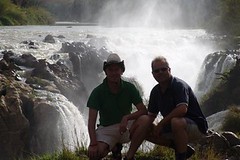
Soon enough, the land developed bumps and hills and we were up art Ruacana. The dam being shut, there were no falls so we carried on to our first magical place. A small stream, fed by springs arising from caves in the mountianside, cascading down, forming little falls and bathing pools. Way out in the wilds, off road on the rockiest and bumpiest of tracks. Beautiful. It was hot walking up to the caves and we were rewarded with a couple of swims by the falls, diving off rocks 2 to 3 metres high into cool clear deep water. Only a couple of donkeys for company.
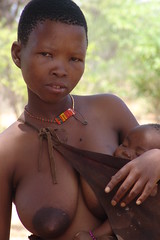
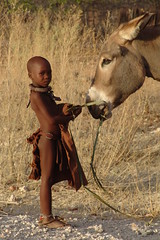
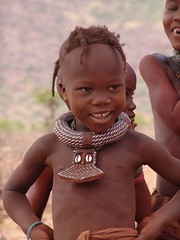
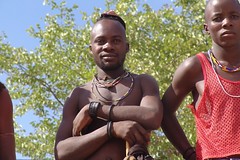
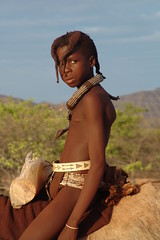
From there, we were entering Himba territory. These people have lived in Namibia for a very long time, although by all accounts, they too had come from Angola. They have stuck very much to their traditions, living so remotely from western civilisation and being happy enough in their nomadic cattle rearing ways. Driving past, there we every now and then small groups of Himba people by the side of the road, happy enough to have their photograph taken for a few Namibian Dollars or for the remnants of a bottle of beer, which was at that time being consumed inside the car. The light was good and I managed to take some pretty good photos. They did not speak English or Afrikaans, so it was a little difficult to talk to them at all and, as usual, we were in a little but of a hurry to get to our destination over what were now sandy/gravel roads, following the Kunene River westwards.
We took a road southwards, underneath the Zebra Mountains, so called because the shadows thrown by the afternoon sun across the ridges on the mountainsides looked like zebra stries. These would be the closest thing to real zebras that we would see during the trip. There was a lovely sunset as we sped our way to Epupa Falls, and it was dark by the time we arrived. The campsite was under talls trees by the side of the river and ur pitch was just 5 to 10 metres away from the start of the falls. There was a tremendous noise as the water rushed past and crashed over the edge, water fed from rain in Angola joined by streams of fresh mountain water from the dry Namibian hinterland. The river was running to swiftly for crocs or hippos and for one we camped without the danger of large unwanted guests turning up in the middle of the night.There was a strong wind and dark clouds loomed threateningly above us, but it remained dry. Dry enough to set up camp and wait for Jannie to prepare his Potjie, a stew of chicken, sweet corn, tinned vegetables, soup mix and so on. Delicious. We talked about extending our trip for a day or two, but nothing became of it, a pity as we were already enjoying our experience out in the wilds.
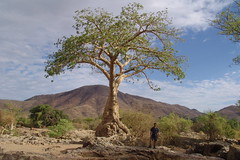
The next day, we were up early to watch the sun bring colour to the banks of the river, lighting up the hills of Angola the other side. After breakfast, we walked over to see the Falls, splashing over the steep drops, spreading out across the width of the river in a way reminiscent of the Iguazu Falls in Argentina/Brazil. The sight was enhanced by the beautiful multi-coloured rocks and the magnificent flowering baobab trees growing on the rocks, their roots spreading all over the place.
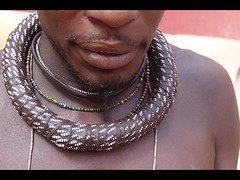
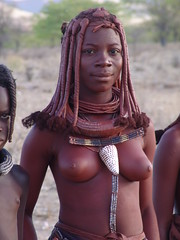
Thereafter, e went to visit the local Himba shop and then to a Himba village where a guide, John, showed us around and explained many facets of the life of the Himba. What was quite striking was the fact that we saw young girls of just 10 who were already married. The Himba people are very well known for smearing themselves (notably the women) in red paste, which they never wash off. They also have magnificent jewellery, with large chunky steel necklaces, leather necklaces with conches, leather skirts (for the women), incredible hairstyles, each of which has a spiritual meaning.. and so on....
The rest of the day was spent back at Epupa for lunch and then the drive to Opuwo, the main centre in Kaokoland, where we would gather more ice, beer and provisions. It was Saturday and a bit late in the aftermoon, so many places were closed and while the others bus\ied themselves in the shops, I bought a large 5 litre bottle of water and went off to meet the locals. Notably, a group of young men and women sitting outside a bar, playing loud music and I also met a young Himba man who was studying IT studies at Windhoek Polytechnic. Sharing the bottle of water around I was told to be careful as ‘these people’ may be infected... hmm.... maybe, maybe not... but it did show how people here tended to be afraid of each other.
Some Himba people would be dressed in a traditional way, all red with leather skirts and greasy jewellery, living in huts of cardboard boxes on the outskirts, while others would be dressed in western clothes. Whatever, both would go to the bars and the shops.. a strange sight indeed... old and new mixing like this.
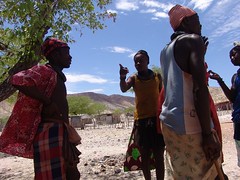
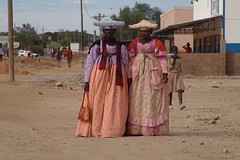
Opuwo is not only a Himba town, but also a place for the Herero people. As it turned out, we did not get to find out too much about the Hereros, save that they are related to the Himbas and also tend cattle. The women dress themselves up in large broad, wide, colourful Victorian dresses with cloths the shape of cattle horns on their heads... have a look at the photos on flickr!
Opuwo also seemed to be full of prostitutes. Maybe it was just the time of day... late Saturday afternoon, young men drinking beer, the bars full of young women in colourful and revealing western clothes, moving their bodies around in a very sexy way..... I am not sure.
From Opuwo it was another long long drive, much in the dark to Purros, where we camped for the night. On the way, we saw a jackal, some ostriches and a giraffe... real wild animals, wandering around the countryside, not in a national or game park.
The next day was spent as one long safari, driving up and back along two river beds, between the mountains. An incredible experience, out in the wilds. Water would spring up from nowhere and form a river for a few kilometres before disappearing again, in the meantime, giving water to the animals. Here we would see many many oryx, such a beautiful animal, plenty of springbok and every so often a small group of desert elephants or desert giraffes and far away, there would be some ostriches running away from us. Later wewoudl see our first Kori Bustard.
The evening was then spent at the site of some hot springs at Ongongo. Just us and a South African couple, on the side of a mountain, with views across the farmland, the sun setting in the west, water falling down a small fall into a beautiful pool, perfect for bathing, while yellow weaver birds tended to their hanging nests in the reeds at the water’s edge. A swim in the evening and a swim in the morning. Delicious and the water tasted so sweet!
The next day was spent in what was now Damaraland, no longer Kaokoland, visiting the bushmen rock carvings at Twyfelfontein and the nearby organ pipes and then to the Burnt Mountain and then to the Petrified Forest. Here we saw logs from trees 280 million years old which had become petrified. They looked so much like logs from trees just cut down yet they existed at the time of the dinosaurs. They can be found only here and in Arizona, both very hot parts of the Earth.
The night was spent at Khorixas, where I managed to recharge the camera batteries and download the photos onto CD’s, just in time as the memory stick was full and the betteries empty. Swam in the pool fed by cool springs overlooking a field with ostriches wandering around, while Jannie prepared a braai of chicken and sausages.
Fred and Jannie would spend much of the day in the car, drinking beer and talking nonsense. Fred was very interested in the Afrikaans language and Jannie in Dutch and it was interesting to spot the similarities and the differences. Afrikaners would say ‘Vogelstruis’ and ‘leker slaap’ whilst the Netherlanders would say ‘struisvogel’ and ‘slaap lekker’. Fred made a mistake at the Khorixas supermarket as he bought 18 bottles of Castle beer instead of the favoured Tafel Beer and he was condemned to drinking it all himself.
Brandberg was our main destination the following day an this would be the most beautiful spot we cane across. A large mountain range 81 kms long and 2,753 metres high at teh highest point would rise from the hot surrounding plain. The rocks were of all colours, mostly red, but also black, white, yellow and grey. The main attraction were the bushmen paintings including the so-called White Lady of Brandberg, which in fact is a medicine man, white with sweat. He had a penis to prove the point, which makes one wonder why the Frenchman in question insisted in describing it as a lady. (The story goes that he could not believe that black people could be capable of such art, so assumed that white people had been there before... but no clue about the sex change!). We were expertly guided by Vanessa, a trainee and then Matthew who had worked at the site since it had become protected, after Namibia’s independence. He knew everything about the geology, biology, botany, astronomy and local tradition attached to the Brandberg. Here was a place I would love to return to, for a trek of 3 to 4 days, when the weather would be cooler... it was HOT again!
A short snooze later at the back of the car and all of a sudden it was cool... we were near the Atlantic Coast. We drove to Henties Bay and then up to Cape Cross where we saw a massive colony of very smelly seals, with many many young pups. They bleated like sheep but smelt of rotten fish. There were thousands of them. Very awkward creatures on land, hobbling around n their flippers, rather painfully for the males, so it would seem. There were many dead pups by the harbour wall and it was hard to believe they were killed by jackals as they had not been eaten.
Next stop was Swakopmund, the main seaside resort of Namibia. Very white. Very German. Great shops. Christmas lights. We first had a dip in the sea, our fifth sea, after the Med, the Dead Sea, the Red Sea, the Gulf of Aden (if that is a sea) and the Indian Ocean. Cool but not cold. Good to see that blacks were now allowed to sit on the colourful benches. We set up camp near the beach and went for a stroll into the empty town, past al the touristy curio shops and bookshops and bier stuhbes and pizzerias. This is Africa too.
The last day was spent on the sand dunes around Swakopmund and nearby Walvis Bay, including climbing up Dune 7, the second highest dune in Namibia after Dune 46 in Sossusvlei, which is teh highest in the world, apparently. We got off sky-diving and dune boarding, had a (disgusting) cheeseburger on the seafront and visited the fishing docks before setting off back on the long 550 km road to Tsumeb. A bit boring at first, the trip back was livened up by spectacular skies of storm clouds, rainbows and thunder and lightning, followed by a near full moon, while by the side of the road we saw many warthogs, some massive and proud kudu bulls, impala, vultures, wildebeest and hartebeest (our first).
We were back at Mousebird afer 10, all still friends, having had a great few days together, but pleased to be back for a day’s rest. We could have done with an extra day between the first and third day, to spend more time with the Himba people, but maybe that is an adventure for another day. Still, Jannie had done his very best to show these two foreigners the very best places of ‘his’ country, a country of which he is very proud. He did a great job and we too, will spread the word about Namibia, particularly Kaokoland and Demaraland.
On Saturday, we will be joining Jannie, with his wife Petra and son Alex, for a three day trip to Etosha National Park, about which we have heard many great stories, despite the fact that it is the rainy season and he game wil not congregate near the waterholes as they do in the dry season. By all accounts, Nigel and Tuomo had a great few days there. Tomorrow, we will join Durk, proprietor of Mousebird, on a trip to visit the San people, out east of here. We think we will bypass the south of the country, which means missing Sossusvlei and Fish River Canyon, but South Africa beckons and we are running out of time.
From there, we will look at possibilities to bus it down to Windhoek and Cape Town, to be in the Cape for Christmas. Thereafter, maybe we will take the train to Durban, hire a car and spend some time in the Zulu Kingdom and maybe the Drakensburg before returning along the coast to Cape Town ready for our flight back in a month’s time. That is the plan.
While I am typing this, in the hope that we DO get internet access today, we are listening to ‘Bianca’ singing ‘Blumen aus Eis’, German carols in a Weihnachten Schlager-style... what a strange country.... !
Fred says hello... as he sits in the pool with a cold Tafel beer.
Labels: Namibia, Trip to Middle East and Africa
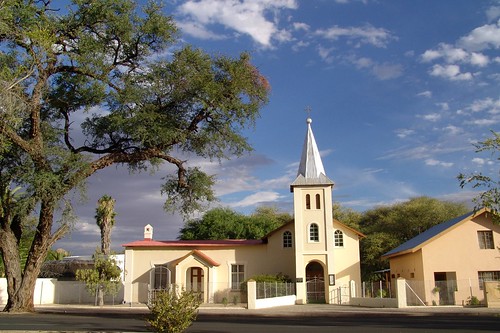 It is odd to think that we have spent as much time here in Tsumeb as we have in almost any other place we have visited (others would be Amman, Asmara, Djibouti, Hargeisa and Addis) as that was certainly not the plan we arrived. As it turns out, we have come to appreciate this small town in the hiils of Northern Namibia, with its large green park, its wide streets bordered by beautiful flowering trees and shrubs – jacaranda, flame of the forest, bougainvillea, its pretty Protestant churches, its small but very interesting and well-presented museum, its row of shops, including the now famous Backerei Steinbach (we never did go back, as Fred did not fancy cockroach-infested Christmas cake or a milky (make that a milky one!) coffee), its now defunct copper mine, its arts and crafts centre, its ‘black’ township, its large white inhabitants, many with tree trunk legs and short shorts, its German biergartens and this odd charming little backpackers residence where we erected and decorated the Christmas tree yesterday evening.